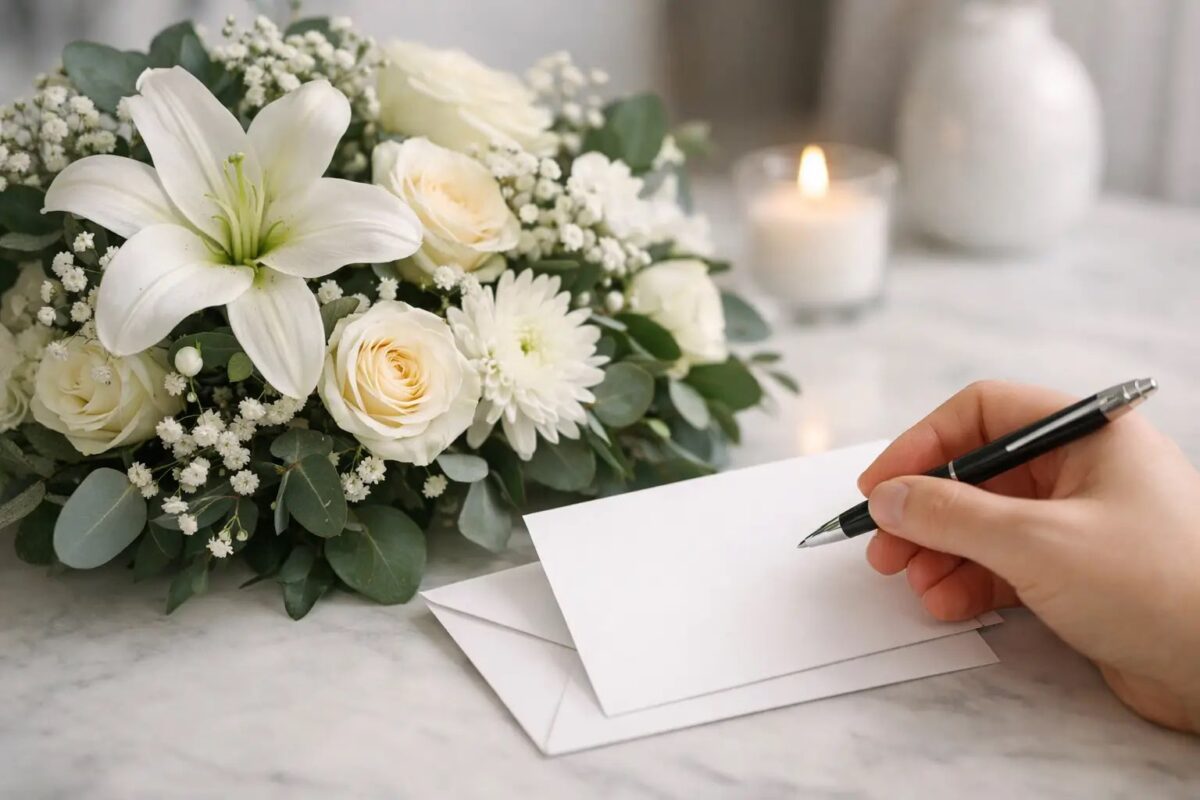
When you are grieving from far away, even a small card can feel heavy. If you are wondering what to write on sympathy flowers, the right words are usually the simplest ones – kind, sincere, and focused on comfort rather than trying to fix the loss.
What to write on sympathy flowers when words feel hard
A sympathy flower message does not need to be long to be meaningful. In fact, funeral cards and ribbon messages are often short by necessity. A few honest words can say more than a long paragraph, especially when the family is overwhelmed and reading many messages in a difficult moment.
The safest approach is to keep your note warm, respectful, and personal. You can acknowledge the loss directly, mention your love or support, and, if it feels right, include the name of the person who has passed away. That small detail makes the message feel less generic and more heartfelt.
If you did not know the deceased well, you do not need to pretend that you did. It is enough to write something simple for the family, such as, “Thinking of you with deepest sympathy” or “Sending love and comfort to your family.” If you were close to the person who passed, you can be more personal and say, “I will always remember Maria’s kindness” or “Javier will be deeply missed and lovingly remembered.”
Keep the message short, sincere, and easy to read
Many people overthink sympathy cards because they are afraid of saying the wrong thing. That is understandable. But in most cases, families are not looking for perfect wording. They are looking for a sign that someone cares.
A good sympathy message usually does one of three things. It offers condolences, shares affection, or reminds the family that they are not alone. You can do all three in one short note, but you do not have to. Sometimes one gentle sentence is enough.
These are the kinds of messages that work well on sympathy flowers:
“With deepest sympathy.”
“Thinking of you during this difficult time.”
“Sending our love and heartfelt condolences.”
“With love and remembrance.”
“Our hearts are with you.”
“In loving memory.”
“Gone but never forgotten.”
“Keeping you in our thoughts and prayers.”
If you want your message to feel a little more personal, add the recipient’s name or the name of the person being remembered. Even a brief line like, “In loving memory of Carlos” can make the arrangement feel more intimate.
What to write on sympathy flowers for different relationships
The best message often depends on who you are sending the flowers to. A note for a close family member will usually sound more personal than one sent to a colleague or family friend.
For close family
If you are sending flowers to parents, siblings, children, or relatives, your message can be tender and direct. You do not need formal language. A line such as, “We are holding you close in our hearts,” or “All our love is with you today,” feels personal without being too long.
If the person who passed away was also meaningful to you, you can say that plainly. “We will miss Dad so much” or “Aunt Elena will always be remembered with love” can be deeply comforting because they honor shared grief.
For friends
For friends, a warm and supportive tone is usually best. Try something like, “I am so sorry for your loss,” or “Sending love to you and your family.” If you knew the deceased, a short memory can also work well, as long as it stays concise enough for a flower card.
For coworkers or professional contacts
If your relationship is more formal, it is better to keep your message respectful and understated. “Please accept our sincere condolences” or “Thinking of you and your family at this sad time” are both appropriate. These messages feel caring without crossing professional boundaries.
For religious families
If you know the family finds comfort in faith, including a spiritual line can feel natural and supportive. “Keeping you in our prayers” or “May God grant you peace and comfort” are common choices. If you are unsure about their beliefs, it is safer to choose a nonreligious message.
Message ideas you can use right away
Sometimes you need a message quickly, especially if you are arranging delivery from another country and want everything handled without extra stress. These examples are short enough for most sympathy flower cards and suitable for many situations.
For a traditional message, you might write, “With heartfelt sympathy,” “Our deepest condolences,” or “Thinking of you with love and sympathy.” These are timeless because they are respectful and easy for any family to receive.
For a more personal message, try, “Sending you love during this painful time,” “We are so sorry and are here for you,” or “Remembering Ana with great love.” These feel warmer and are often best when you know the recipient well.
For memorial arrangements or funeral wreaths, many people choose very brief wording such as, “In loving memory,” “Forever in our hearts,” or “With love and remembrance.” When the card is attached to a formal tribute, shorter is often better.
For flowers sent to a home after the service, you can be slightly more conversational. “Wishing you comfort in the days ahead” or “Sending love to your family and thinking of you” can feel especially appropriate after the funeral, when the first wave of support may have quieted down. Continue reading “What to Write on Sympathy Flowers”